
























Use this guide when a duration crosses midnight or a calendar interval crosses an awkward boundary. You will verify an overnight time, compare elapsed dates across leap day, and interpret a month-and-days result without replacing calendar rules with fixed-day shortcuts.
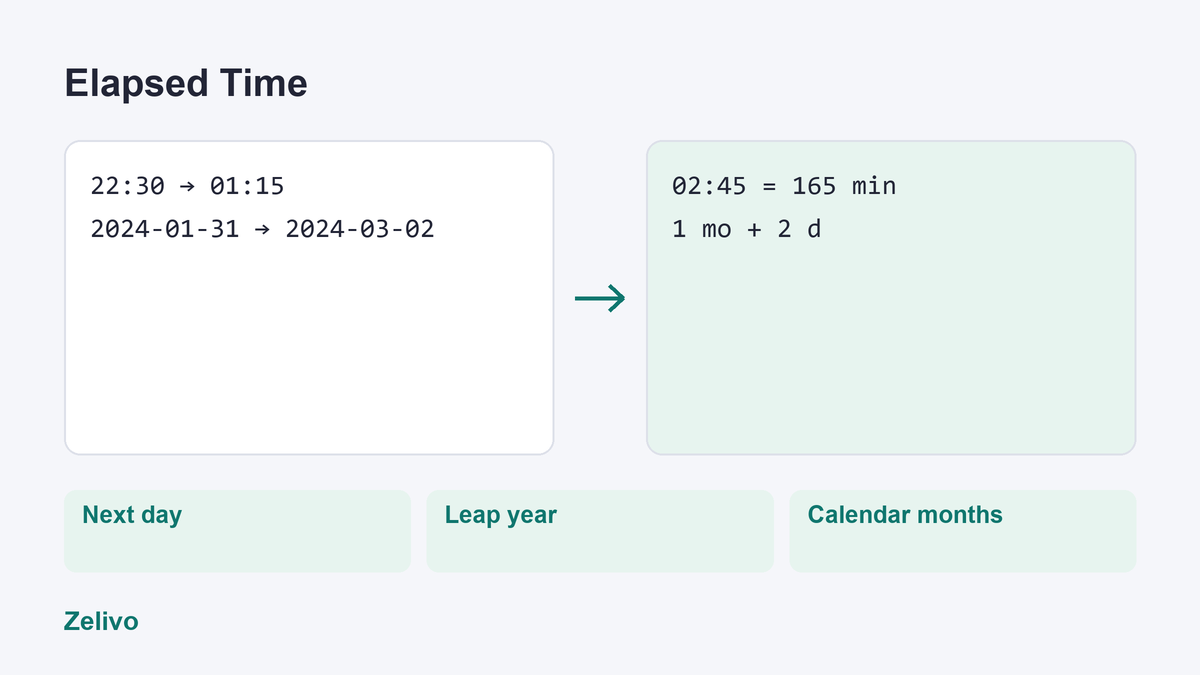
Split an Overnight Clock Interval at Midnight
Start with the hours calculator for a short interval whose end reading appears earlier than its start. Enter the start as 22:30 and the end as 01:15. The calculator treats the earlier end as the next day, so the interval remains a forward span rather than a negative result. This convention applies to a span under 24 hours.
22:30 → 01:15
02:45 = 165 min
Verify the result by splitting the clock interval into two pieces. From 22:30 to midnight is 90 minutes. From midnight to 01:15 is 75 minutes. Adding them gives 165 minutes, which is 02:45. Equal start and end readings produce zero. The calculation ignores time zones and daylight saving, so it measures clock readings only.
Count Elapsed Dates Through a Leap Day
For calendar dates, use the days calculator and enter 2024-02-28 as the start and 2024-03-01 as the end. The interval crosses the midnight transition into February 29 and then the transition into March 1. Because 2024 is a leap year, the elapsed difference is two days, not one. Keep the dates in chronological order.
2024-02-28 → 2024-03-01
2024-03-01 − 2024-02-28 = 2 d
Reproduce the answer by counting midnight crossings: February 28 to February 29 is one elapsed day, and February 29 to March 1 is another. If your task means counting every named date touched, include February 28, February 29, and March 1, giving three dates inclusively. That inclusive count is a different definition from elapsed duration.
Interpret Month-and-Day Results by Calendar Rules
The month calculator measures whole calendar months plus remaining days. Try 2024-01-31 → 2024-03-02. Because February has fewer than 31 days, the tool uses February 29 as the next monthly anniversary. The move from January 31 to February 29 counts as one month. The two midnights crossed from February 29 to March 2 supply the remaining days.
The expected output is 1 mo + 2 d. Recheck it by tracing that clamped anniversary rather than assuming every month has a fixed length. A rule such as 30 days per month cannot replace the calendar definition. Definitions matter: elapsed days, inclusive dates, and calendar months answer related but distinct questions. Reversed inputs return the same absolute difference.
Three Checks Before You Trust the Result
- Split overnight time at midnight and add the two clock segments.
- For date spans, distinguish elapsed midnights from inclusive endpoint dates.
- For month intervals, follow the tool’s calendar anniversary and remaining-day rule.
